Your spice cabinet has a secret, and honestly, it’s a little sad. Those dusty jars from 2015 aren’t doing your cooking any favors. Let’s fix that, one jar at a time. Okay, when was the last time you opened your spice drawer and actually smelled something? If your cumin doesn’t smell like cumin anymore, just sort of like, dusty air, we need to have a conversation. Spices and herbs are the soul of great cooking that is why this spices and herbs storage is very important.
They are the reason a simple chicken dish can taste like it came from a Moroccan kitchen, or why your grandmother’s tomato sauce was impossible to replicate. But here’s the thing, they’re perishable. They have a shelf life. And most of us are completely ignoring that fact.
Knowing the difference between herbs and spices isn’t just a fun dinner-party fact, it actually changes how you should store them. Their moisture levels, volatility, and ideal conditions differ just enough that treating them the same is one of the most common kitchen mistakes people make.
Heat, light, humidity, and air are the four villains silently stealing flavor from your spices every single day. Poor storage doesn’t just flatten taste, it kills aroma, drains color, and shortens shelf life dramatically. The good news? A few simple changes can extend freshness by years.
If you have been experiencing this, you do not need to panic because we are going to fix this together and make sure your kitchen smells better, your food taste better, and you’ll never have to panic-sniff a jar of paprika before a dinner party again
Difference Between Herbs and Spices
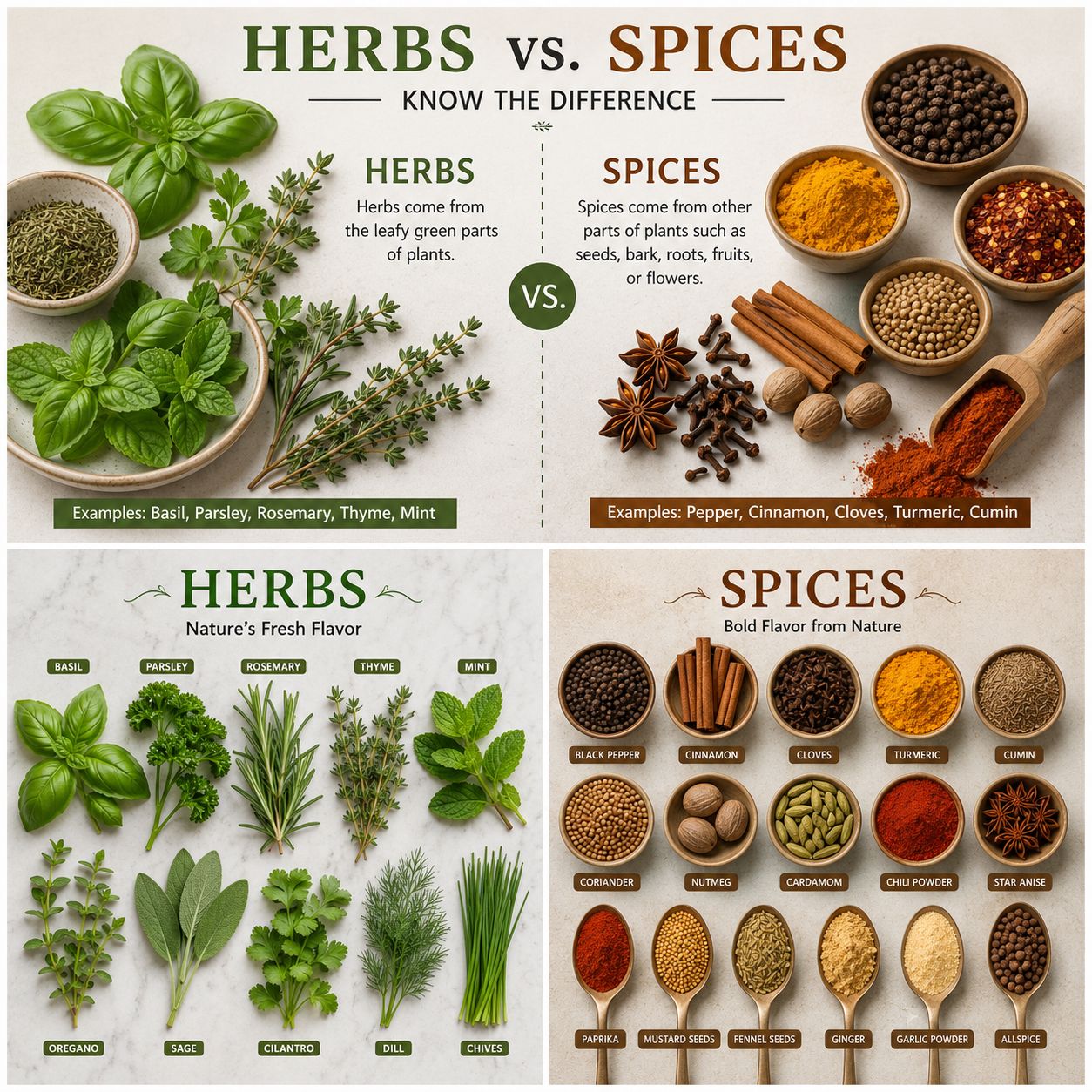
You have probably used the words “herbs” and “spices” interchangeably your whole life, and honestly, most people do. But here’s a fun little kitchen secret, they are actually quite different things, and understanding that difference is the first step to storing them properly.
Herbs
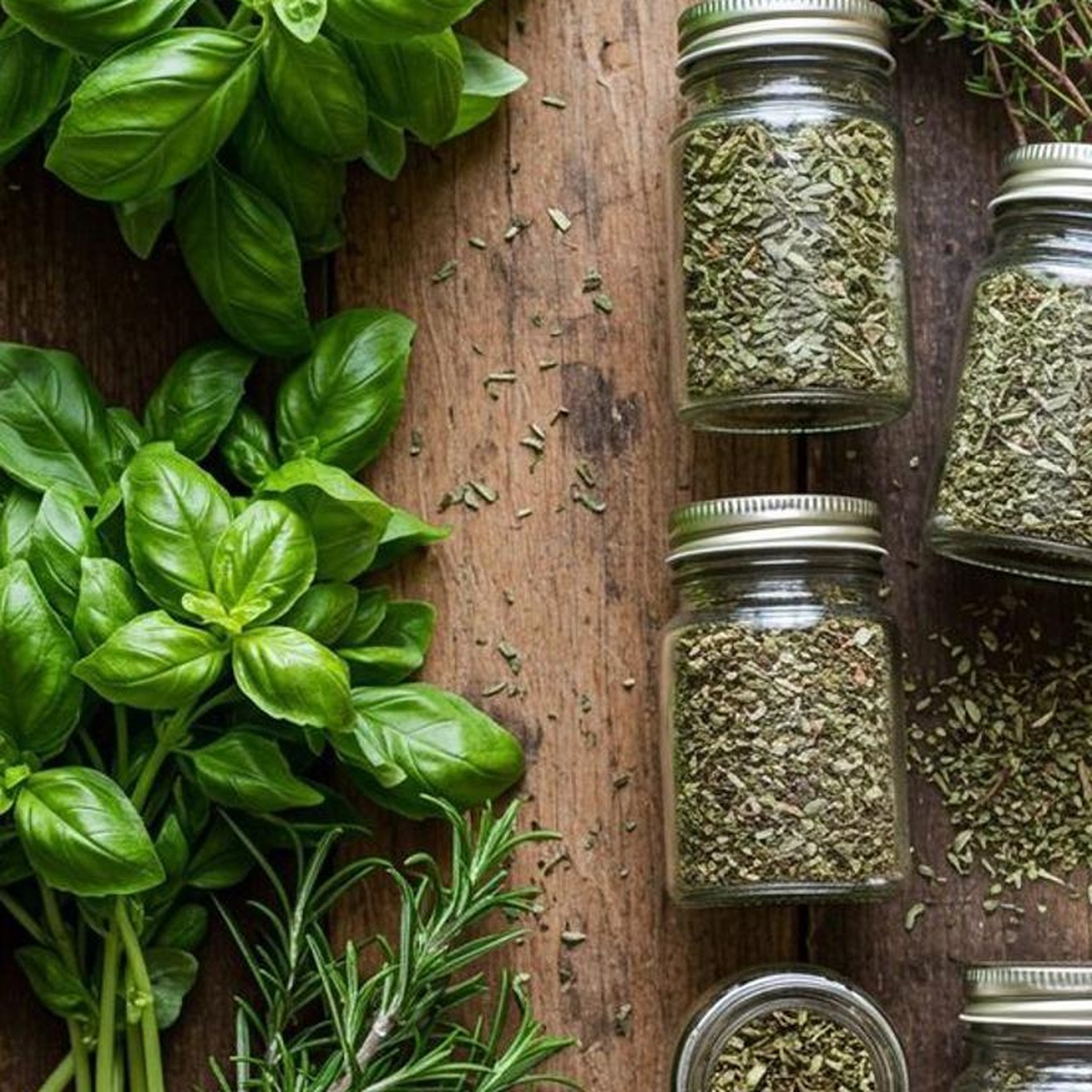
The leafy, green, fragrant parts of a plant. Herbs come from the leaves of plants, sometimes stems too. They tend to be soft, moisture-rich, and highly aromatic. Think of them as the fresh, green side of the flavor world. They can be used fresh or dried, and they bruise easily, which is exactly why they need a little more care. Common examples are basil, parsley, oregano, thyme, rosemary
cilantro, mint
Spices
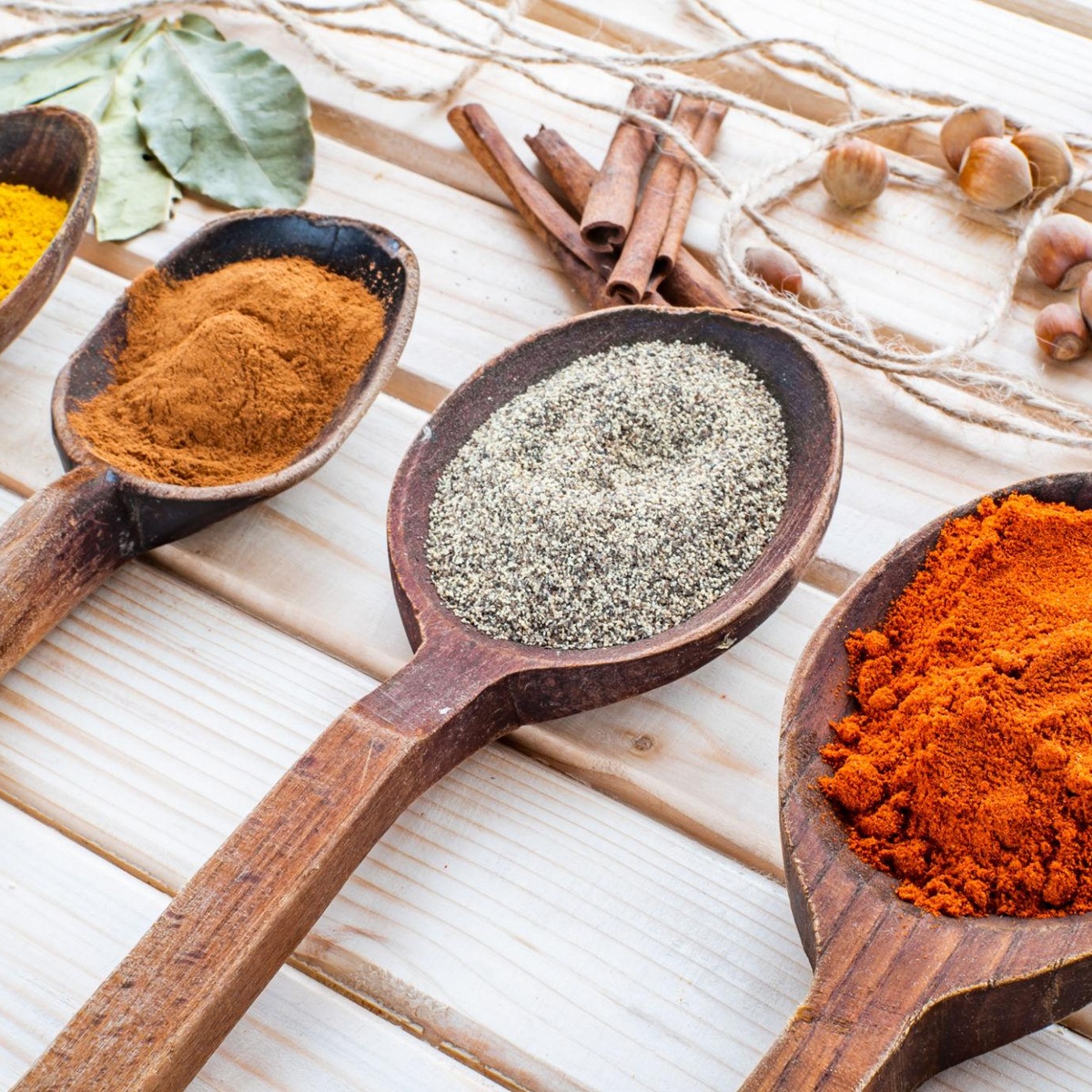
The seeds, bark, roots, and fruits of a plant. Spices come from deeper parts of the plant, seeds, bark, roots, or dried fruit. They are naturally drier and more concentrated, which generally gives them a longer shelf life. Their flavors are bold and intense, packed into hard, shelf-stable forms that hold up well when stored correctly.
A quick rule of thumb: if it’s green and leafy, it’s an herb. If it came from the seed, root, bark, or fruit of a plant, and it’s usually dried or ground, it’s a spice. There are a few rebellious exceptions (coriander is both a leaf herb and a seed spice depending on which part you’re using!), but that mental shortcut will serve you well in most cases.
Why their storage needs differ
Spices and herbs storage differ because herbs and spices don’t age the same way, and treating them identically is one of the most common kitchen mistakes people make.
Herbs are moisture-sensitive
Dried herbs lose their flavor rapidly when exposed to humidity. Fresh herbs, on the other hand, actually need a little moisture to stay perky, think of them like cut flowers. They’re the divas of the kitchen world.
Spices are heat and light sensitive
The concentrated oils in spices are powerful, but they break down quickly under direct sunlight or high temperatures. That pretty rack of spices sitting above your stove? That’s a flavor graveyard. We’ll fix that later in this guide.
Their shelf lives are very different
Whole spices can last 3–4 years with good storage. Dried herbs, being more delicate, typically stay fresh for 1–3 years. Fresh herbs? You’re looking at days to a week or two at most, but don’t worry, we have tricks for that too.
Herbs and spices both reward a little attention and care. They’re not difficult to store well, you just need to know what they actually need. And now that you understand the difference between them, the rest of this guide is going to make a lot more sense.
Why proper spices and herbs storage is important
You wouldn’t leave a good bottle of olive oil open on a sunny windowsill, right? Same logic applies to your spices and herbs. How you store them has a direct, real impact on how your food tastes, and how much money you spend in the kitchen.
Most people don’t think about spice storage until something goes wrong, a curry that tastes like warm dust, a pasta sauce that’s somehow missing its soul, or a spice jar that’s three years past its best. By the time you notice the problem, you’ve already wasted dozens of meals (and a fair bit of money). The good news is that fixing this is genuinely easy once you know why it matters.
Let’s break it down into the four big reasons proper spices and herbs storage is worth your attention.
It preserves flavor and aroma
Every spice and herb gets its distinct flavor and smell from volatile aromatic compounds, tiny, fragile molecules that evaporate or degrade when exposed to heat, air, or light. When those compounds break down, the flavor goes with them. What you’re left with is the shadow of a spice: the color might still be there, the texture unchanged, but the taste? Completely flat.
Proper storage in airtight containers, cool dark spaces, slows that breakdown dramatically. It’s the difference between paprika that smells smoky and rich versus paprika that smells like absolutely nothing.
It prevents moisture damage
Moisture is possibly the most destructive force in your spice cabinet. When humidity gets into a spice jar, it clumps the powder together, creates the perfect environment for mold, and kickstarts a process of chemical breakdown that ruins flavor fast. Even the steam that rises when you shake a spice jar directly over a boiling pot is enough to cause damage over time.
Herbs are especially vulnerable here. Dried herbs that absorb moisture lose their crispness and their flavor, and in worst cases can even grow bacteria. Keeping everything sealed in airtight containers, and using a dry spoon to measure, goes a long way.
Moisture causes clumping , mold, flavor loss, bacterial growth. You can prevent it by using airtight lids, dry spoons, keeping them away from steam
It saves you money by reducing waste
Think about how often you’ve thrown out a half-used jar of spice because it smelled like nothing, or watched fresh herbs go limp and yellow in the fridge within two days. That’s real money going in the bin, and it adds up faster than you’d think. Quality spices, especially whole ones like saffron, cardamom, or vanilla, can be genuinely expensive.
When stored correctly, spices last years longer. You buy less often, waste less, and you’re not tempted to over-use a faded spice just to compensate for its lost potency. Proper storage is, quite literally, one of the cheapest upgrades you can make to your kitchen.
Whole spices stored well can last 3–4 years. Poorly stored ground spices? Sometimes as little as 6 months before the flavor is essentially gone.
It maintains food quality and cooking consistency
This one often gets overlooked, but it’s arguably the most important for anyone who loves to cook. Great recipes are built on consistent measurements. When you follow a recipe that calls for one teaspoon of cumin, you’re trusting that one teaspoon delivers a certain amount of flavor. But if your cumin is two years old and badly stored, one teaspoon barely registers, and suddenly your dish tastes nothing like it should.
Fresh, well-stored spices mean you cook with precision. Your family recipes taste the same every time. Your guests rave. Your confidence in the kitchen grows, because the ingredients are actually doing their job.
Think of it this way: Properly stored spices are reliable. And reliability is what separates a good cook from a great one.
Good storage keeps flavors bold, blocks moisture damage, stretches your grocery budget, and makes you a more consistent cook. None of this requires expensive equipment or a kitchen overhaul, just a few smart habits. And that’s exactly what the rest of this guide is here to give you.
Best containers for storing spices and herbs
The jar you choose matters more than you think. Not all containers are created equal, and the wrong one can quietly rob your spices of flavor before you even open them. Here’s everything you need to know to pick the right vessel for your spices and herbs storage.
Walk down any kitchen aisle and you’ll find endless options, fancy spice sets, magnetic tins, stackable towers, plain old mason jars. It’s easy to get overwhelmed. But the truth is, you don’t need anything expensive or elaborate. You just need to understand what actually makes a good spice container, and what to avoid.
Glass for spices and herbs storage
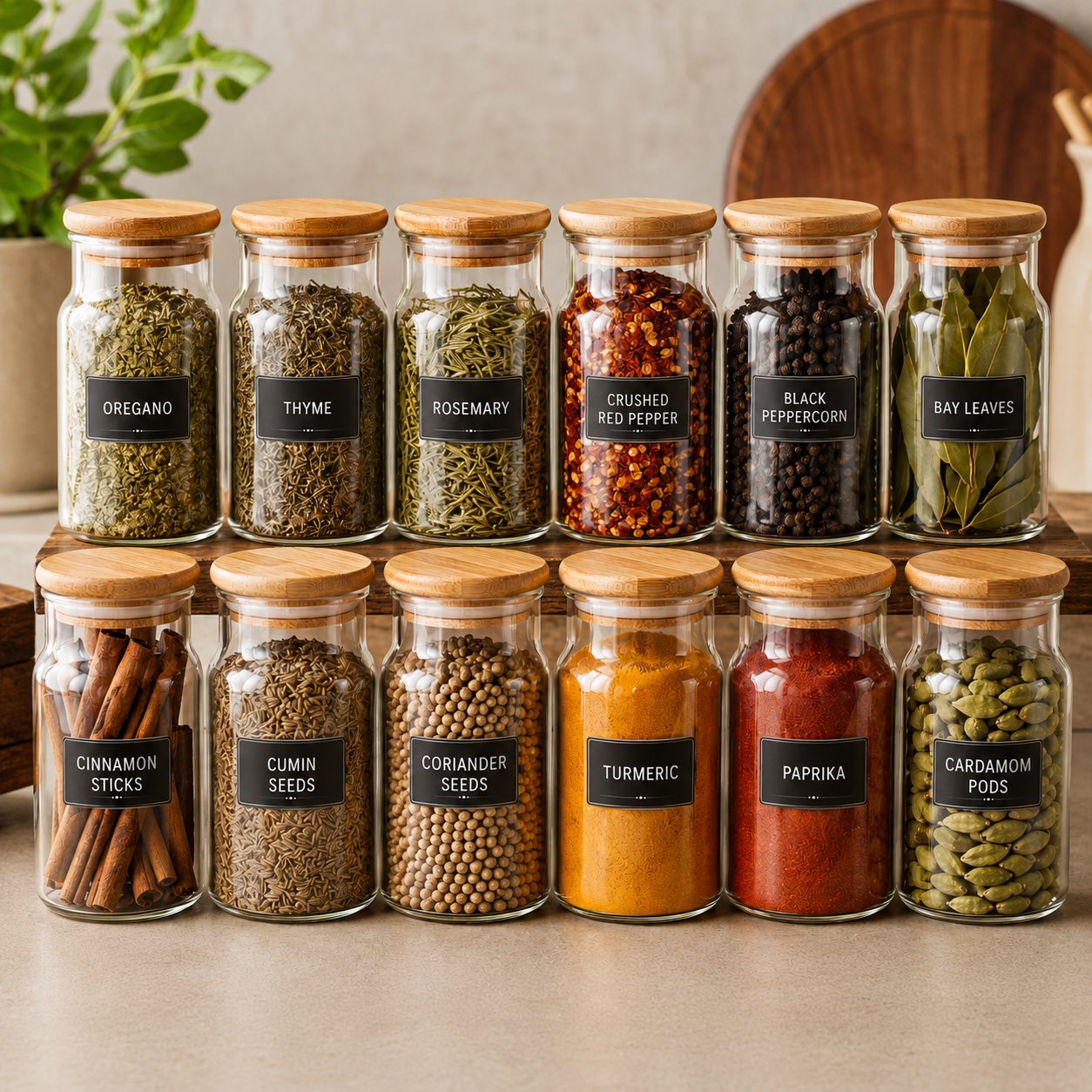
Glass is the winner because it is:
Plastic for spices and herbs storage
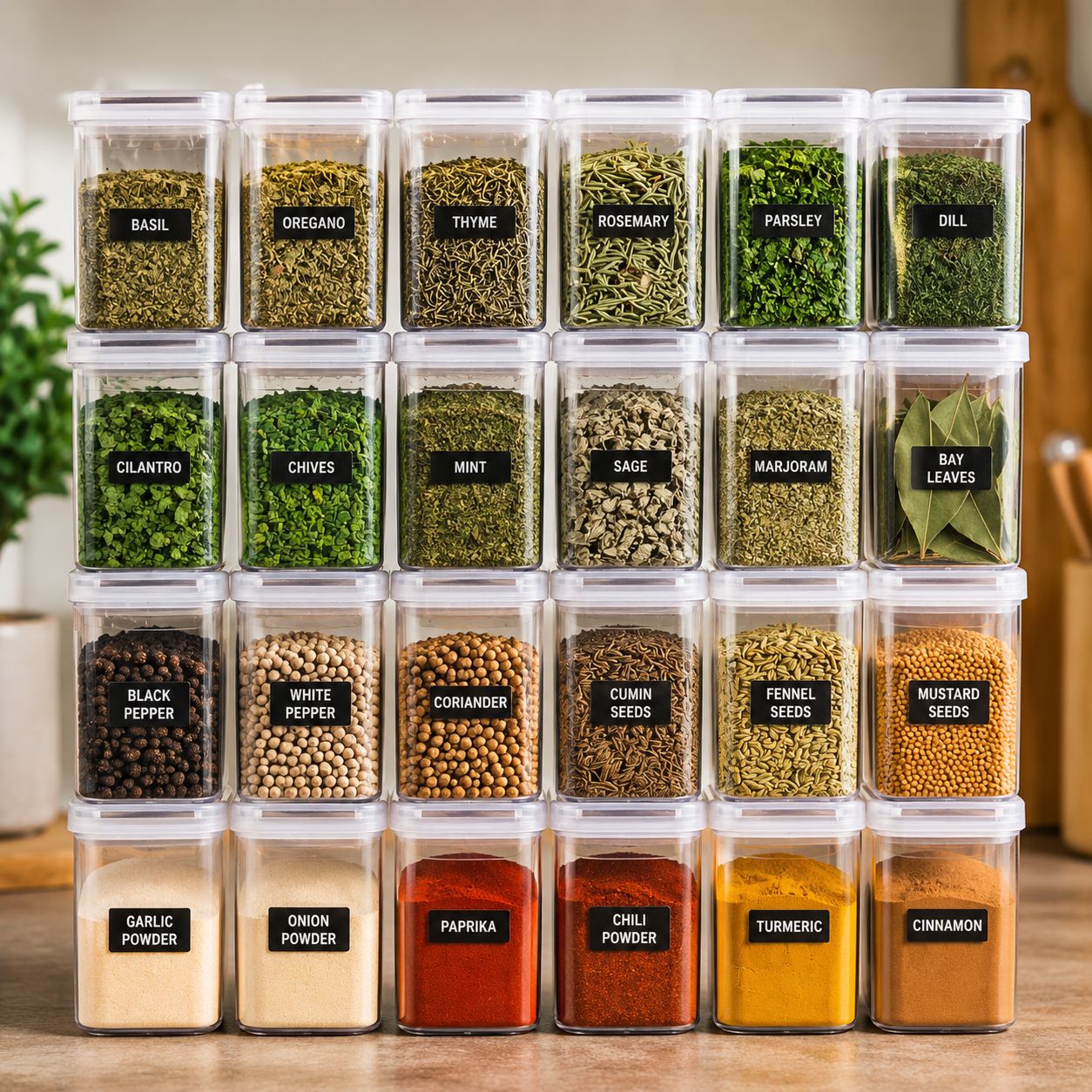
You need to use plastic with caution, because it:
Airtight containers — non-negotiable
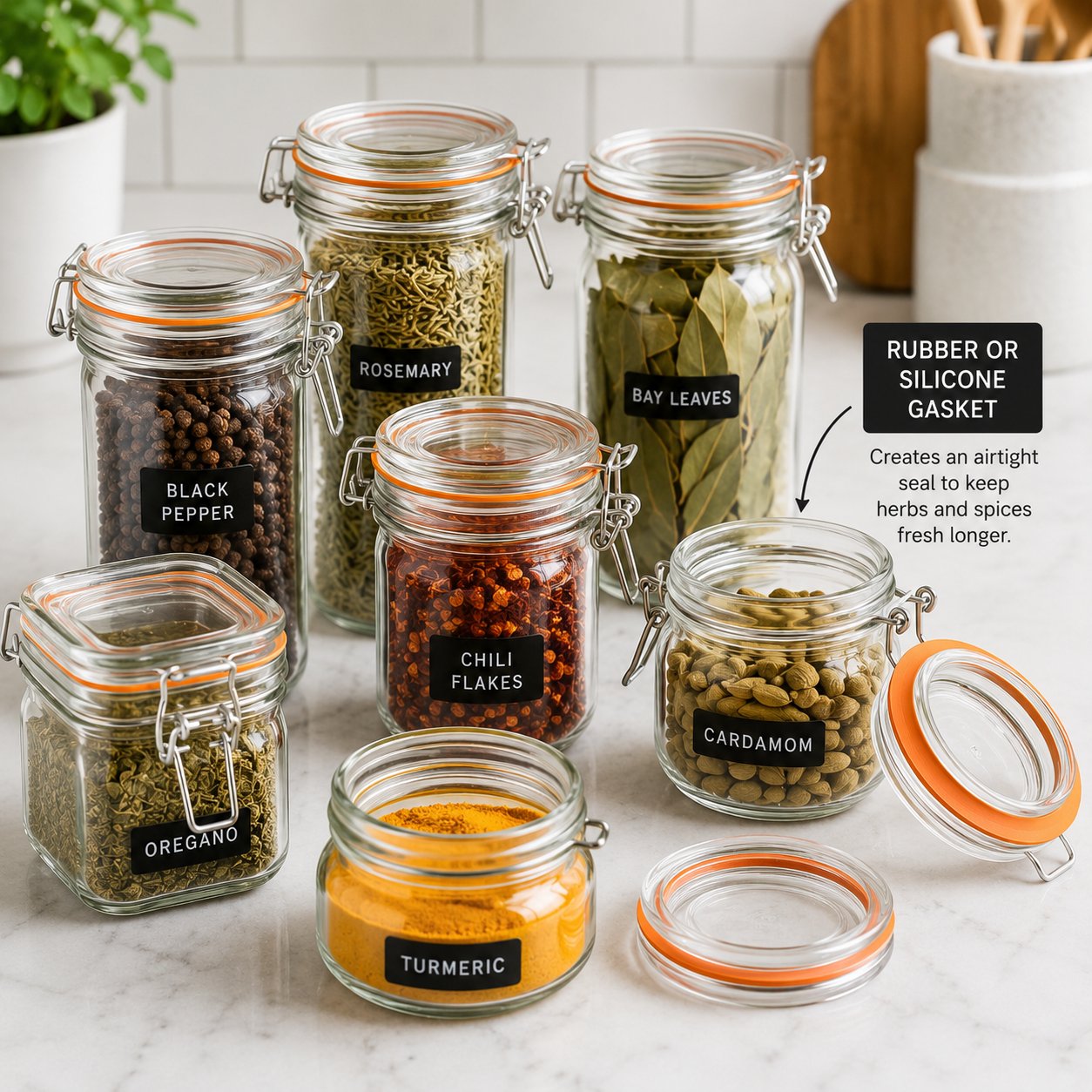
If there’s one rule in spices and herbs storage that overrides everything else, it’s this: always use airtight containers. Oxygen is one of the primary culprits behind flavor degradation. Every time air gets into your spice jar, it slowly oxidizes those precious aromatic compounds, dulling flavor and aroma one molecule at a time.
Look for containers with rubber or silicone gaskets on the lid, these create a proper seal that keeps air and moisture out. Screw-top lids are decent. Snap-lock or flip-top lids with a gasket? Even better. Loose-fitting lids with no seal? A slow death sentence for your spice collection.
Quick check: Pick up one of your spice jars and close the lid firmly. Does it feel snug? Is there a rubber ring? If not — it’s time for an upgrade
Labelled containers — more important than you think
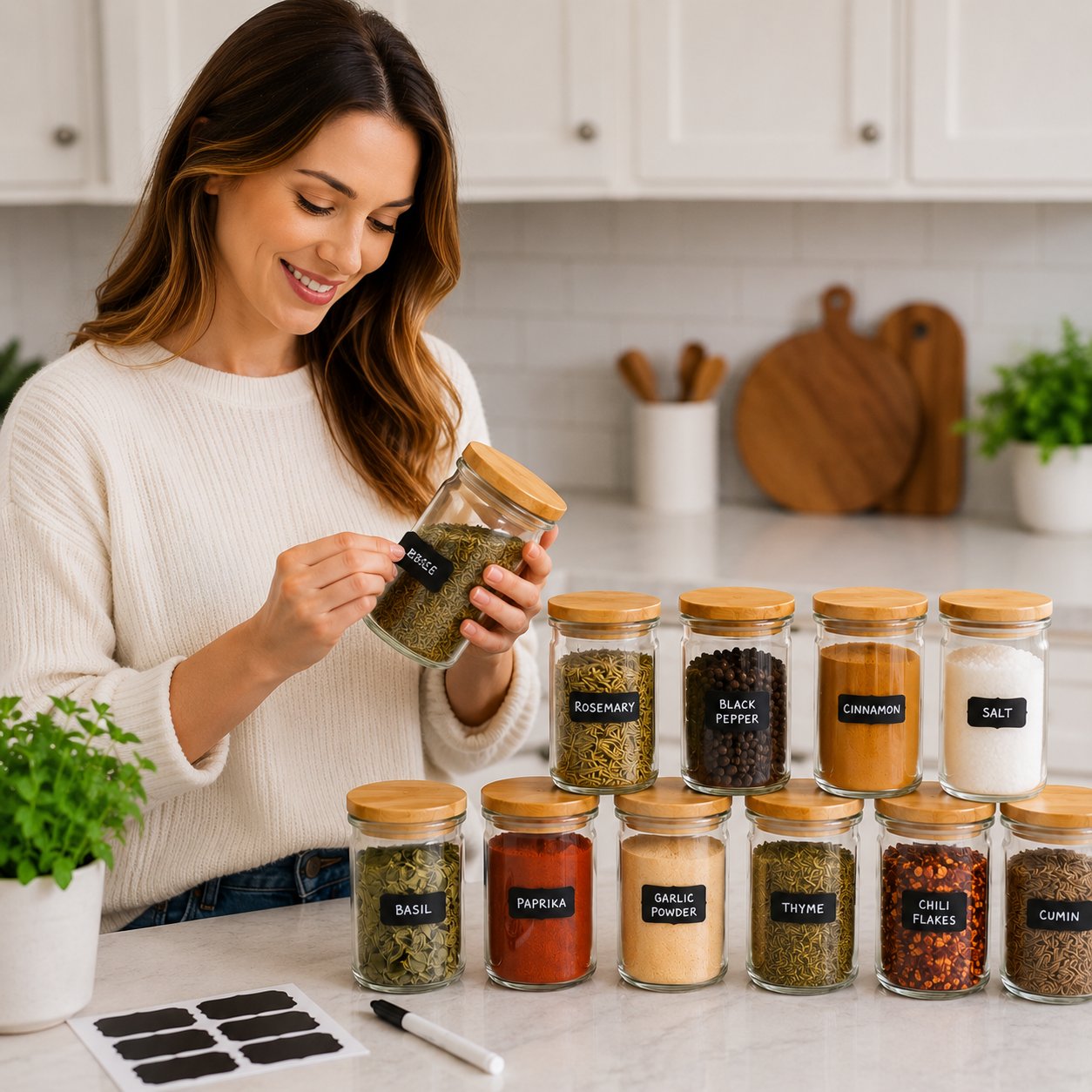
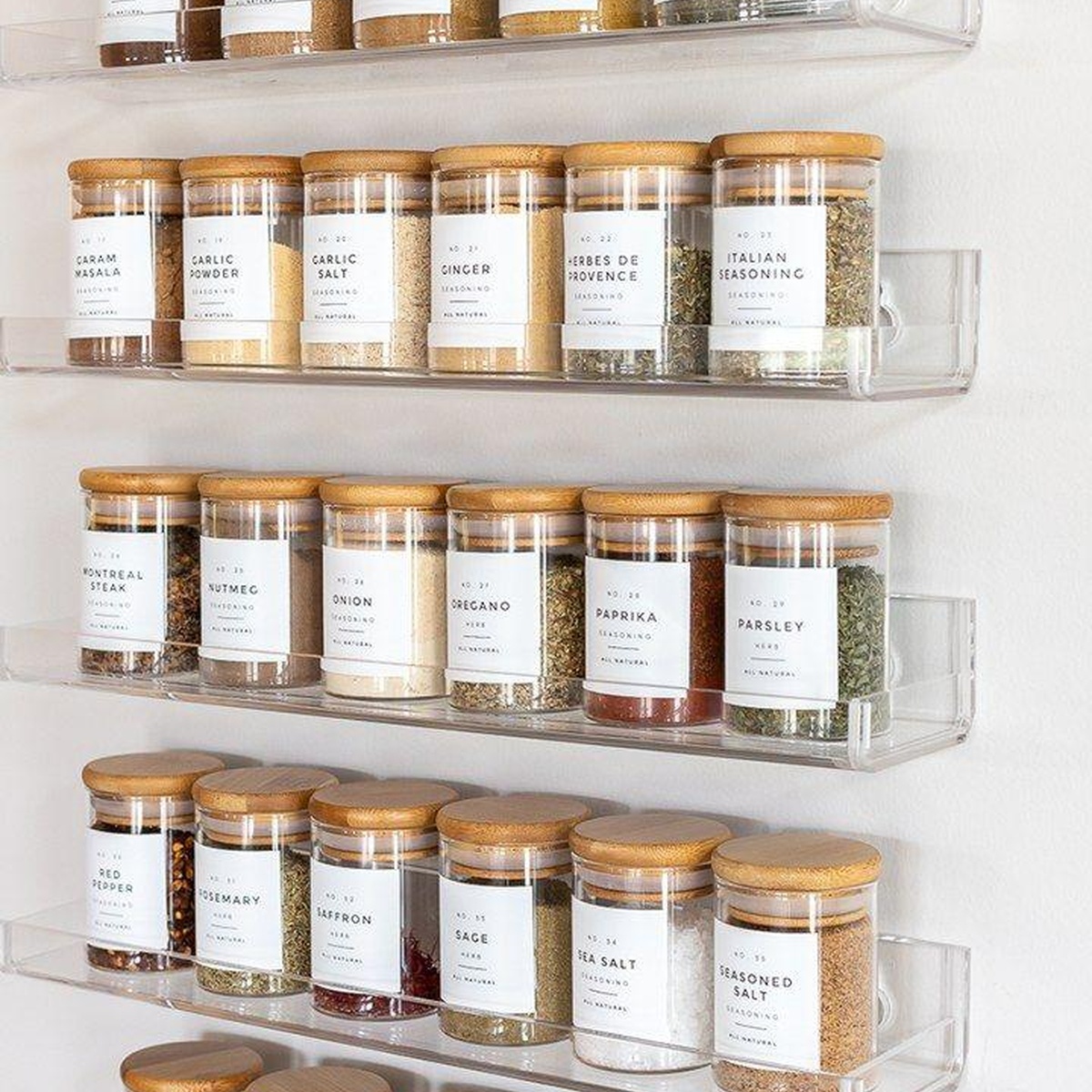
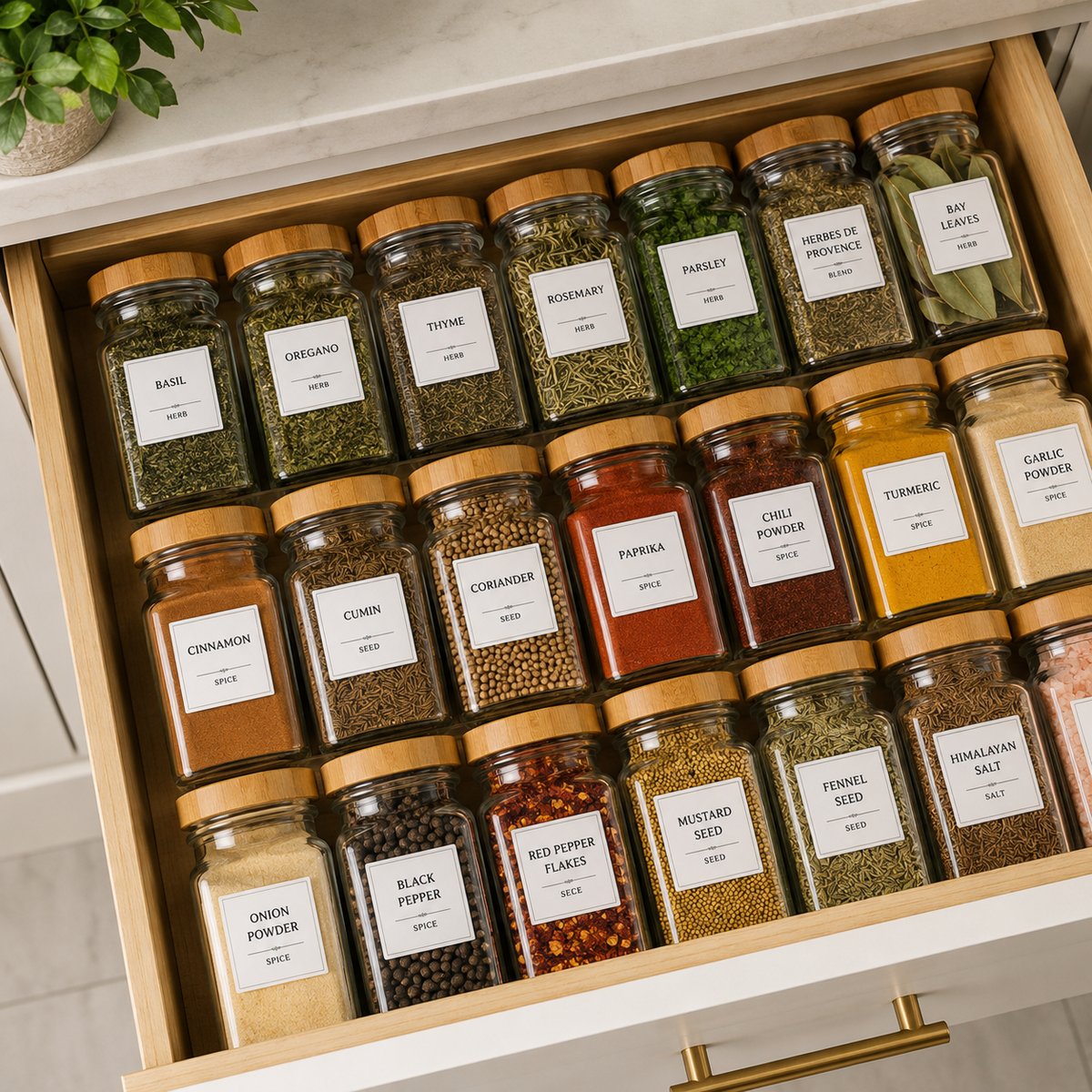
This one sounds obvious until you’re standing in your kitchen at 7pm, squinting at three nearly identical brown powders trying to figure out which is cumin, which is coriander, and which is, wait, is that mixed spice? Label your containers for spices and herbs storage. Every single one.
But don’t just write the name, include the date you filled or purchased it. That tiny detail helps you rotate stock properly, throw out expired spices without guilt, and keep your shelf genuinely fresh rather than a graveyard of mystery jars.
What to include on your label
Spice name · Date filled · Expiry (optional)
Labelling options
Chalkboard labels · Masking tape · Printed stickers
Clear vs. dark containers in spices and herbs storage — does it matter?
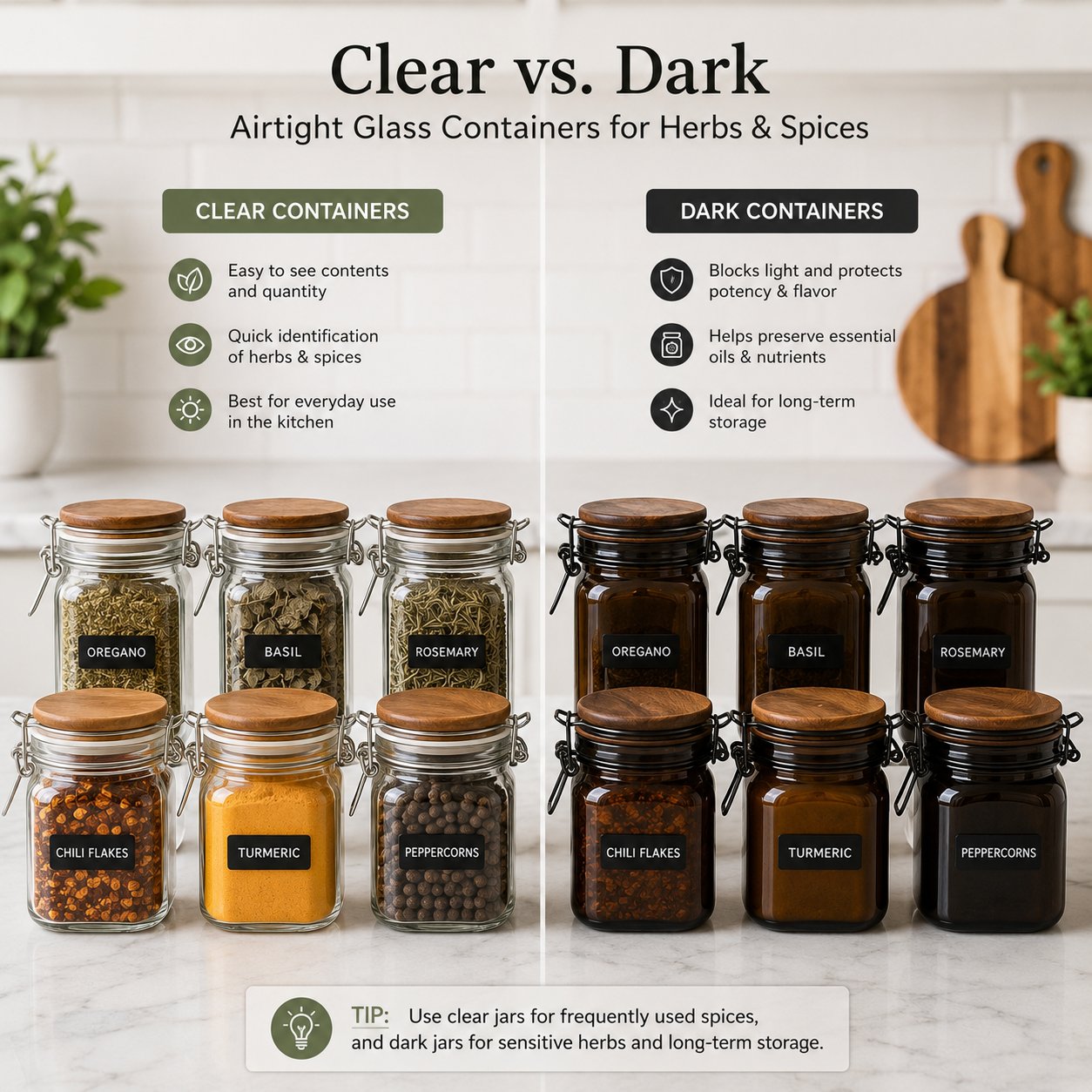
Yes, if your containers are stored in the light. Dark or amber-tinted containers block UV light, which is one of the sneakiest destroyers of spice quality. Light degrades color and breaks down essential oils, which is why your red chilli powder slowly turns orangey-brown on a sunny shelf.
Clear jars in a dark cabinet = perfectly fine. Clear jars on a bright windowsill = fast flavor loss. If in doubt, go dark.
Reusing old spice jars — yes you can, but do it right
Great news for the budget-conscious: you absolutely don’t need to buy new jars. Reusing old spice jars or glass food jars is totally fine, and actually a very smart, eco-friendly move. You just need to prep them properly so old flavors don’t linger and contaminate your new spices and herbs.
How to safely reuse a spice jar:
Wash the jar and lid with hot, soapy water, thoroughly.
Let it air-dry completely, never fill a damp jar. Moisture = trouble.
Do a smell test, if the jar still smells of its old contents, soak in diluted white vinegar for 30 minutes and rewash.
Check the lid seal, if the rubber gasket is cracked or deformed, replace the lid or the jar.
Label it fresh, remove old labels completely so there’s no confusion later.
Ideal storage conditions for spices and herbs
You’ve got the right containers for spices and herbs storage, now let’s talk about where to actually put them. Because even the best glass jar with the tightest lid won’t save your spices if they’re sitting in the wrong environment.
Spices and herbs are a bit like good wine, they thrive in specific conditions and suffer when those conditions aren’t met. The four biggest threats to your spice collection are heat, light, humidity, and air (we handled air in the last section). Get those three under control and your spices will stay vibrant, flavorful, and fresh for as long as possible.
Let’s go through each one, and then talk about one very specific, very common storage mistake that most home cooks are making right now.
Keep away from heat
Heat is the number one flavor killer. When temperatures rise, the volatile oils inside your spices, the compounds responsible for all that taste and aroma, evaporate at a much faster rate. A spice that could last two years at room temperature might lose its potency in just a few months when stored in a warm spot.
Ideal temp: Below 21°C (70°F). The cooler, the better, but room temperature in a shaded cupboard works well for most kitchens.
Avoid direct sunlight
UV rays from sunlight break down the chemical structure of spice compounds, causing rapid color fading and flavor loss. That beautiful red paprika slowly turning a dull orange? That’s sunlight at work. Even indirect bright light can do damage over weeks and months.
Best spots: Inside a closed cupboard, a drawer, or a pantry shelf away from windows. If jars are on display, use dark or amber containers.
Protect from humidity and moisture
For spices and herbs storage, kitchens are naturally humid places, steam from boiling pots, running dishwashers, and even just breathing all contribute to moisture in the air. When that moisture gets into your spice jars, it clumps powders together, speeds up degradation, and in worst cases creates conditions for mold.
Avoid: Storing near the sink, dishwasher, or any area that regularly produces steam. Always use a dry spoon when measuring.
Cool, dry places — the golden rule
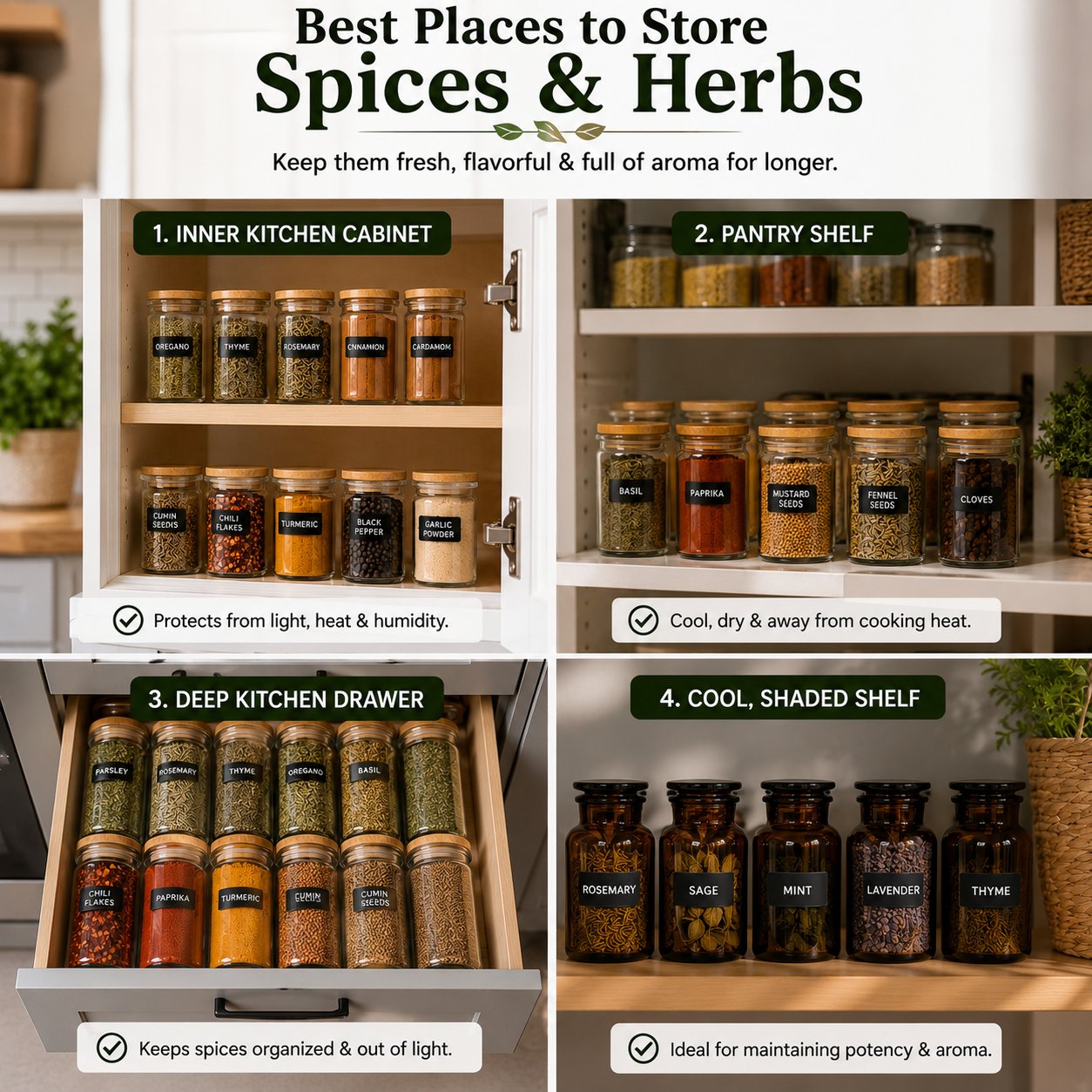
“Cool and dry” is the mantra of every good spice storage system. A closed kitchen cupboard away from the oven, a deep drawer, or a pantry shelf are all ideal. These spots naturally maintain lower temperatures, block light, and keep humidity at bay, all without any special equipment.
Best locations: Inner kitchen cabinet · Pantry shelf · Deep kitchen drawer · Away from appliances that generate heat.
Why storing spices and herbs near the stove is a bad idea
The most common kitchen mistake people make in spices and herbs storage, and one of the easiest to fix
Here’s a scene that plays out in millions of kitchens every day: a gorgeous spice rack, neatly arranged, sitting right next to or above the stove. It looks great. It’s super convenient. And it is absolutely ruining your spices.
The area around your stove is quite literally the worst possible place to store spices in your entire kitchen. Here’s why:
Constant heat exposure
Every time you cook, the surrounding area heats up, and your spice jars heat up with it. Over hundreds of cooking sessions, this sustained heat exposure rapidly depletes the aromatic oils that make your spices worth using.
Steam and cooking vapors
Steam from boiling water and cooking pots rises and settles on everything nearby, including your spice jars and their lids. Even tiny amounts of moisture sneaking in through the lid over time will clump and degrade your spices.
Light from overhead fixtures
Kitchen task lighting above the stove shines directly onto spice racks placed there. Combined with heat and steam, the light adds a third layer of degradation, a triple threat that drains freshness fast.
Repeated heating and cooling cycles
The temperature swings from cooking then cooling stress the jars and lids repeatedly. This weakens seals over time, and a compromised seal means more air getting in, making things even worse.
Easy fix: Move your spices to a cupboard on the opposite side of the kitchen from the stove. Yes, it’s slightly less convenient to reach. But your spices will last dramatically longer and your food will taste noticeably better. That’s a trade worth making.
Quick reference for spices and herbs storage — good spots vs. bad spots
Store here:
Avoid these spots:
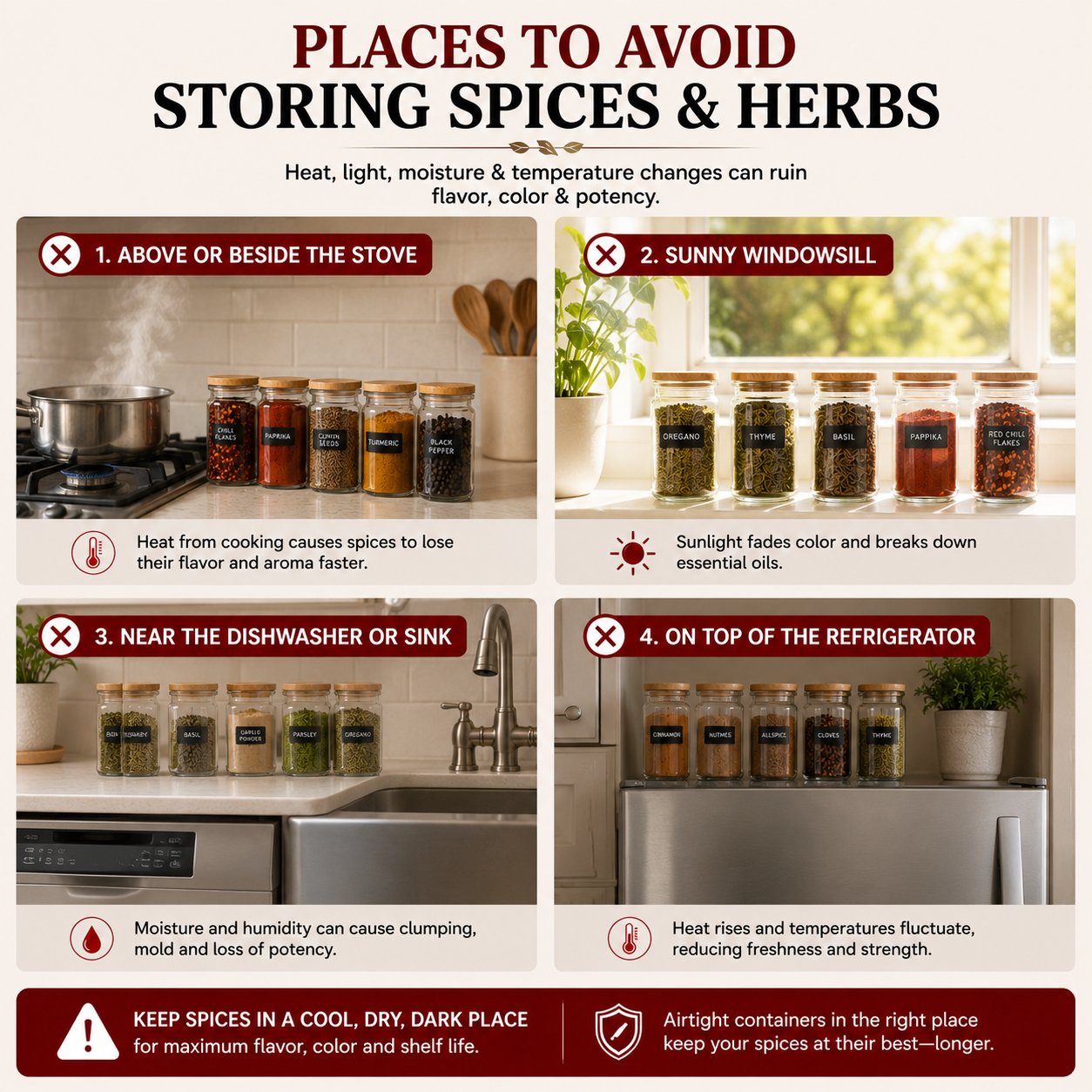
Above or beside the stove
Sunny windowsill
Near the dishwasher or sink
On top of the refrigerator
How long spices and herbs stay fresh
Here’s the truth nobody tells you at the checkout about spices and herbs storage, spices don’t last forever. But knowing exactly how long yours should last, and how to tell when they’ve given up the ghost, is a genuine kitchen superpower.
Unlike milk or bread, spices don’t go off in a way that’s obvious or dangerous. They don’t smell rotten or grow visible mold (most of the time). They just quietly fade, losing aroma first, then flavor, then color, until one day you’re adding tablespoon after tablespoon and your dish still tastes like warm nothing.
The shelf life of a spice depends on two key things; how processed it is and how well it’s stored. Let’s break it all down.
Whole spices (3-4 yrs)
The outer shell of whole spices acts as a natural protective barrier, locking aromatic oils inside until you crack, grind, or crush them. This is why a cinnamon stick lasts years longer than ground cinnamon.
e.g. cloves · cinnamon sticks · peppercorns · star anise · cumin seeds
Ground spices (1-2 yrs)
Grinding destroys that protective barrier and exposes a far greater surface area to air, light, and heat. Flavor and aroma begin escaping immediately after grinding, which is why freshly ground spices are so dramatically more potent than pre-ground ones.
e.g. ground cumin · paprika · turmeric · cinnamon · chilli powder
Dried herbs (1-3 yrs)
Dried herbs sit in the middle, more delicate than whole spices but sturdier than pre-ground ones. Their shelf life varies: robust herbs like rosemary and thyme last closer to 3 years, while delicate ones like parsley and chives fade faster.
e.g. oregano · basil · thyme · rosemary · bay leaves · parsley
Pro tip: Buy whole spices whenever possible and grind them yourself as needed. A small spice grinder or mortar and pestle gives you far more flavor per teaspoon, and your whole spices will outlast pre-ground versions by years.
Signs your spice has lost its potency
Spices don’t go bad in a dramatic way, they just quietly retire. Here are the telltale signs that a spice or herb has seen better days:
Little to no smell
Aroma fades before flavor. If you can barely smell it when you open the jar, it’s already fading.
Faded or dull color
Vibrant red paprika turning orange-brown, bright green herbs going grey-green, color loss signals flavor loss.
Clumping or caking
Moisture has gotten in. The spice may still have some flavor but its shelf life is now shortened significantly.
Bland taste
When cooking feels “off” and you keep adding more spice without result, the spice, not your recipe, is the problem.
The 30-second freshness test
Not sure if a spice is still good? Don’t guess. Do this quick two-step test right now, it costs you nothing and takes under a minute:
The smell test
Rub a small pinch of the spice or herb between your fingers to release the oils, then bring it close to your nose and inhale. A fresh spice should hit you immediately, bold, distinct, recognizable. If you have to really search for the aroma, or if it smells musty and stale, it’s time to replace it.
The color check
Pour a small amount onto a white plate or paper and look at the color. Fresh spices are vivid, deep red, bright yellow, rich brown. Faded, washed-out, or greyed-out colors are a clear sign that the spice has lost most of its potency, even if it’s technically within its “use by” date.
Make it a habit: Do a full spice cabinet freshness audit twice a year, once in January and once in July works well. Toss anything that fails the smell and color test, and restock with small quantities of fresh replacements.
Whole spices last longest, ground spices fade fastest, and dried herbs sit somewhere in between. But the date on the jar is only a guideline, your nose and eyes are the most reliable tools you have. Trust them, test regularly, and never be afraid to throw out a spice that’s past its best. Your cooking is worth it.
Common spices and herbs storage mistakes to avoid
Here’s the honest thing about spics and herbs storage mistakes they don’t announce themselves. There’s no alarm that goes off when you leave a lid loose, no warning label on the jar you’ve kept since 2020. The damage just quietly accumulates, one flat curry, one underwhelming chilli, one “something’s off but I can’t figure out what” meal at a time.
Read through these five, be honest with yourself about which ones you’re guilty of, and fix them one by one. Your future meals will thank you.
Storing above the stove
We’ve touched on this before, but it deserves its own spotlight because it’s so incredibly common. That spice rack hanging above the hob looks like a chef lives here. It feels convenient, reach up, grab, season, done. But every single time you cook, those jars are soaking up heat, steam, and cooking vapors that are actively destroying what’s inside them.
It’s not just the heat from the flame either. The residual warmth that lingers after cooking, the steam rising from simmering pots, and the grease particles floating through the air all settle on your spice jars and work their way in over time. A spice that should last two years stored well might barely make it to six months above the stove.
This is why this is bad, Heat + steam + light = the perfect storm for rapid flavor loss, you can fix this by moving spices to a cool cupboard on the opposite side of the kitchen
Using wet spoons
This one happens in a split second and most people don’t think twice about it: you’re stirring a pot, spoon in hand, you grab your jar of paprika and dip the same slightly-damp spoon straight in. Done in two seconds. Completely harmless looking. Actually quite damaging.
Any moisture introduced directly into a spice jar kickstarts clumping and can introduce bacteria or mold into the whole container. It doesn’t take much, even the residual moisture from a “dry-looking” spoon that was recently washed is enough to cause problems over time. And once moisture gets in, there’s no taking it back.
Simple rule: Always use a clean, bone-dry spoon or measure spices into your hand or a small dish first, then add to the pot. Never dip directly from a cooking spoon. It takes two extra seconds and makes a real difference.
Buying too much at once
It feels smart in the moment, a massive jar of ground coriander for practically the same price as a small one. Why wouldn’t you buy the big one? The problem is that every time you open that oversized jar, you’re exposing a large volume of spice to air, and you’re probably using it slowly enough that it’ll be well past its prime before you reach the bottom.
Bulk buying makes sense for whole spices you use constantly, black pepper, cumin seeds, coriander seeds. But for ground spices or less-used herbs, smaller quantities that you actually get through within a year are far better value than a large jar of flavourless powder.
Here is the big trap, big jar + slow use = most of it goes stale before you finish it, but smarter approach is buy small, buy fresh, restock often, especially for ground spices
Leaving lids loose
You’re mid-cook, moving fast, adding spice after spice. The lid goes on, but not all the way on. You’ll tighten it properly later. Except later never comes, and that jar sits slightly open for days, quietly venting all its aromatic oils into the air. You might even notice your kitchen smells faintly of cumin. That smell is your cumin leaving.
A loose lid also lets humidity sneak in, starts the clumping process, and in warm kitchens can accelerate mold growth in dried herbs. It sounds like a tiny thing. Over weeks and months, it’s genuinely significant.
Good habit to build: Give every lid a firm twist before putting it back on the shelf. Make it automatic, open, use, close properly, put away. That full sequence every time keeps your spices sealed and fresh.
Keeping expired spices for years
Ah, the expired spice hall of fame. There’s always that one jar that’s been at the back of the cabinet since before you can remember, the mixed spice from a Christmas three years ago, the smoked paprika you bought for one recipe and never used again, the saffron someone gifted you in 2019. Sound familiar?
Keeping old spices and herbs isn’t just a waste of shelf space, it’s actively misleading. When you’re cooking and you reach for something that looks fine, you use the same amount as always, and then wonder why the dish tastes flat. The spice is the culprit, but you’ll blame the recipe. Old spices don’t make food dangerous, they just make it mediocre. And mediocre food is its own kind of tragedy.
Action step: Right now, yes, after you finish reading this, go to your spice cabinet and do the smell test on every jar. Be ruthless. If it doesn’t smell like something, it isn’t doing something. Throw it out and restock with a fresh, small jar.
None of these mistakes are hard to fix, they’re just habits. And like any habit, once you’re aware of them and consciously do the right thing a few times, the better behavior becomes automatic. A few small corrections today means better-tasting food for years to come.
Fresh herbs storage tips
Fresh herbs are the most perishable things in your kitchen, and the most frequently wasted. That bunch of cilantro you bought on Monday? By Thursday it’s already halfway to becoming compost. Here’s how to actually keep them alive and kicking.
Fresh herbs are the ultimate kitchen luxury, a handful of fresh basil, a sprig of rosemary, a bunch of vibrant cilantro can completely transform a dish in a way no dried herb quite replicates. The frustrating part? They’re notoriously short-lived. Most fresh herbs start declining within days of being cut, and a fridge that’s too cold, too dry, or too poorly organized can speed that decline up dramatically.
The good news is that with just a little intentionality, you can extend the life of fresh herbs from a few days to several weeks, and with freezing or drying, you can preserve that fresh flavour for months. Here’s your complete playbook.
Refrigerating leafy herbs
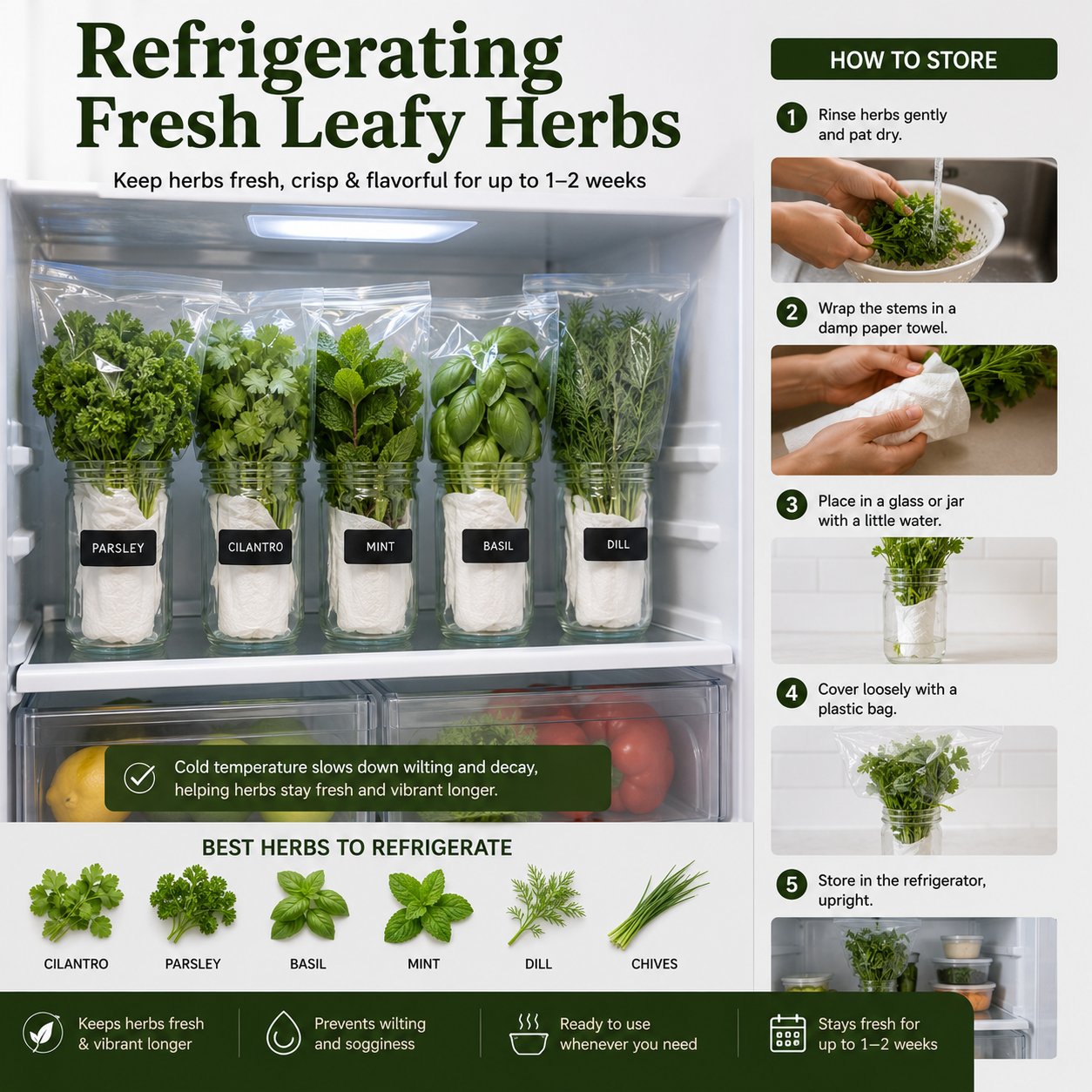
Most leafy herbs, think parsley, cilantro, mint, chives, and dill, do best in the refrigerator, but only if they’re stored correctly. Just tossing them loosely in the crisper drawer without any preparation is one of the fastest routes to a soggy, yellowing mess within two days.
How to refrigerate herbs properly
Remove any rubber bands or ties, these bruise and crush the stems.
Trim the ends of the stems on a slight angle, this opens up the stem for better water absorption.
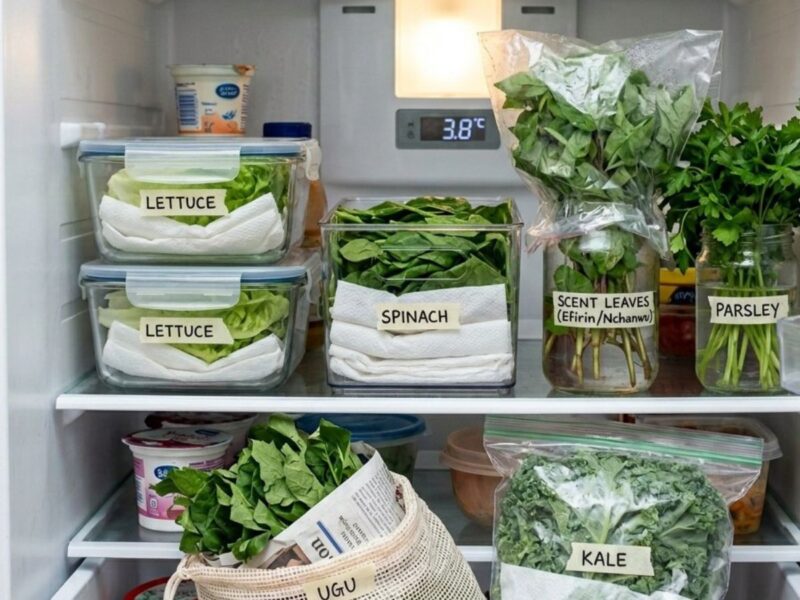
Wrap loosely in a slightly damp paper towel before placing in a container or bag.
Store in the fridge door or the least-cold part of the fridge, most herbs hate freezing temperatures.
Fridge-friendly herbs
Parsley · Cilantro · Mint · Dill · Chives · Tarragon
Keep at room temperature
Basil · Lemongrass, cold damages these; keep on the counter
Using paper towels to absorb moisture
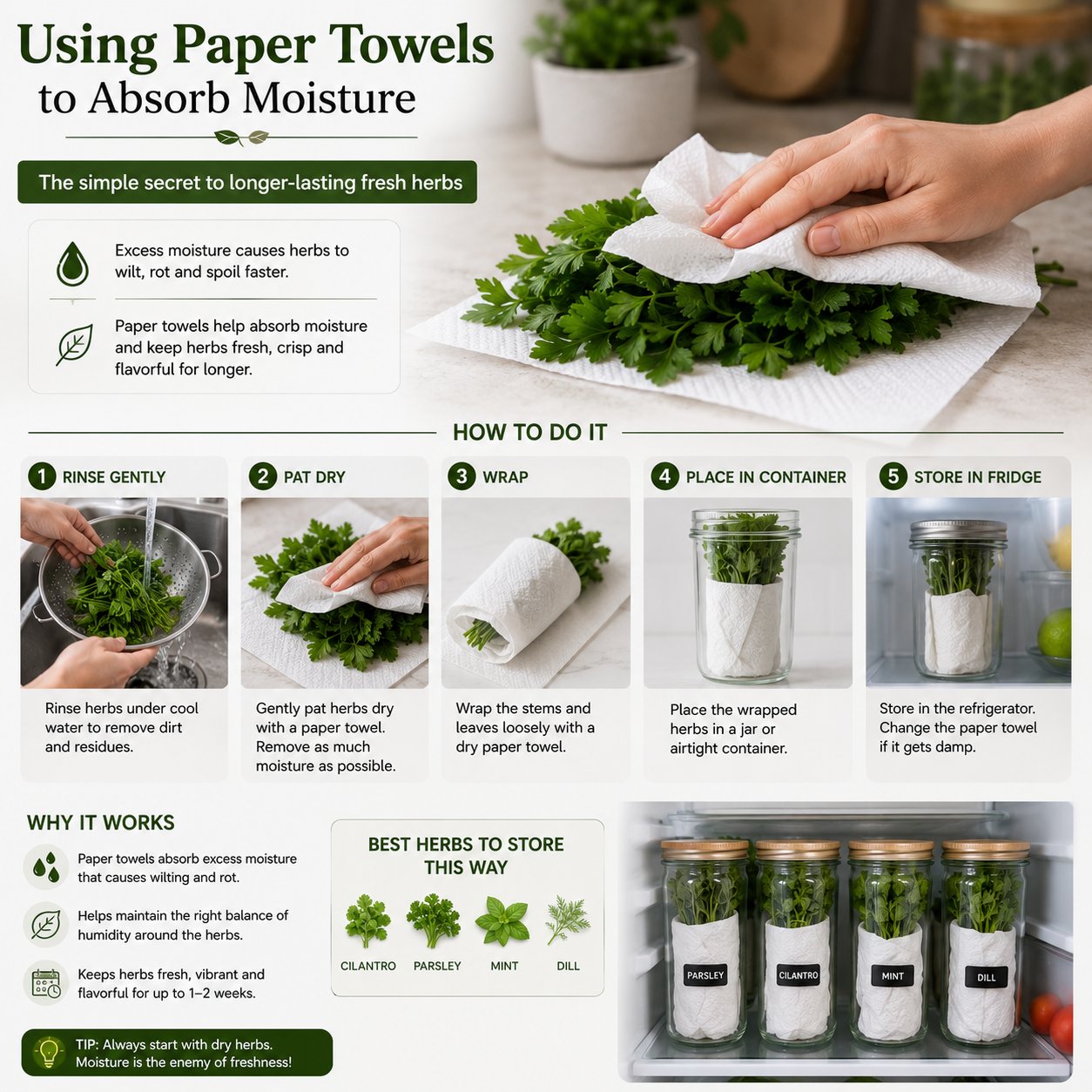
Paper towels are genuinely one of the best tools in your fresh herb storage arsenal, and they cost almost nothing. The goal is to create an environment that’s slightly humid without being wet. Too dry and herbs wilt and shrivel. Too wet and they rot and turn slimy. Paper towels walk that line perfectly.
The method is simple: lay your herbs on a paper towel, roll or fold it loosely around them, and place inside a sealed zip-lock bag or airtight container. The paper towel absorbs any excess moisture that would otherwise settle on the leaves and cause rot, while keeping enough humidity in the air around the herbs to stop them drying out.
A clean, barely damp cloth or reusable cotton kitchen towel works just as well as paper towels, and produces zero waste. Rinse and reuse between herb batches.
Storing herbs in jars with water
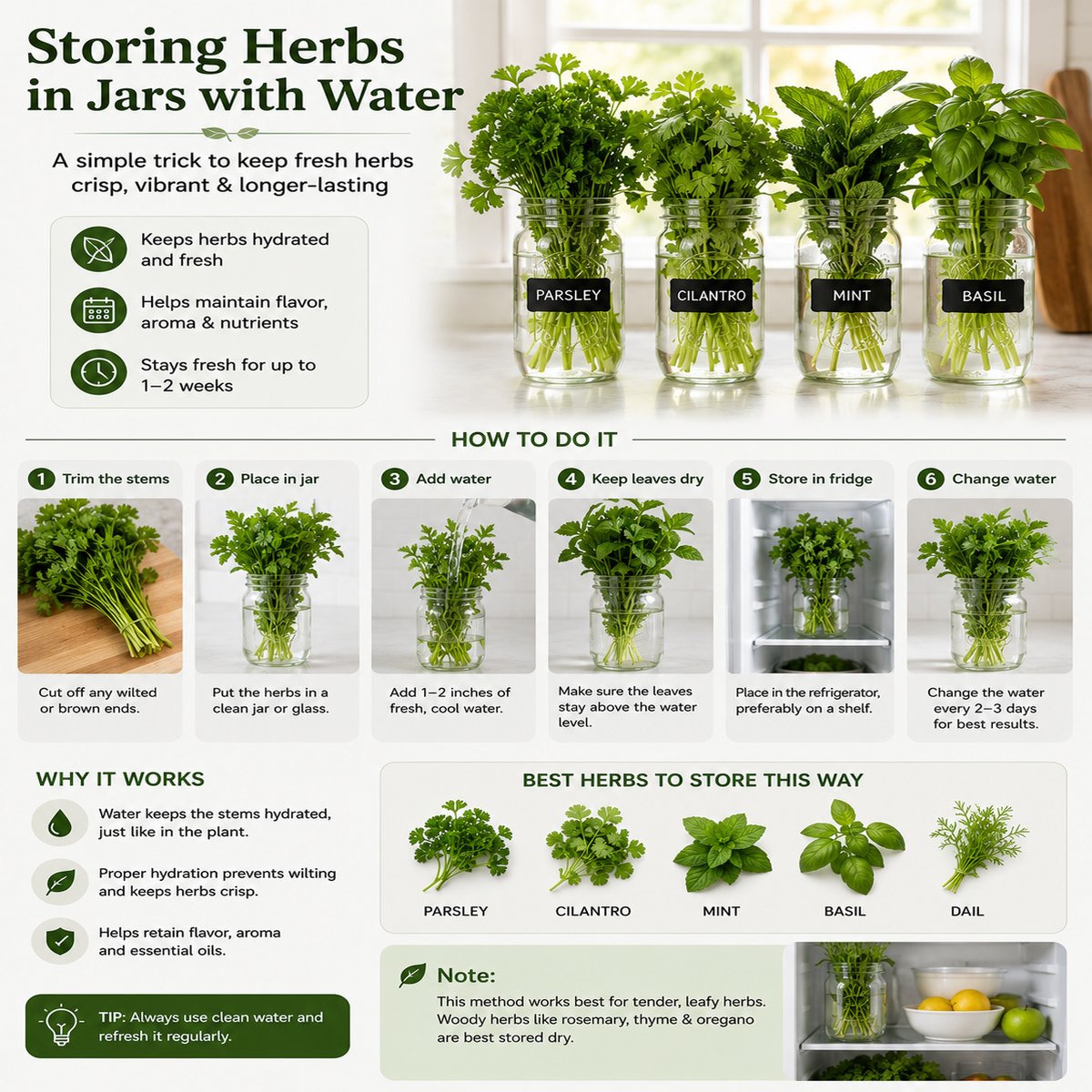
Think of this as treating your herbs like a bunch of flowers, because that’s essentially what they are. Herbs with long stems like parsley, cilantro, mint, and basil last significantly longer when stored upright in a small jar or glass with an inch or two of water at the bottom. It keeps the stems hydrated and the leaves perky far longer than any other method.
In the fridge
Place a loose plastic bag or wrap over the top. Works beautifully for parsley, cilantro, dill, and mint. Change the water every 2–3 days.
On the counter
Best for basil, it hates the cold. Keep in a jar of water on the counter, away from direct sun. Treat it exactly like a small bouquet.
How long it lasts: Parsley and cilantro in a water jar in the fridge can stay fresh for up to 2–3 weeks, compared to just 2–4 days in a bag without water. That’s a dramatic difference for such a small change.
Freezing herbs for long-term use
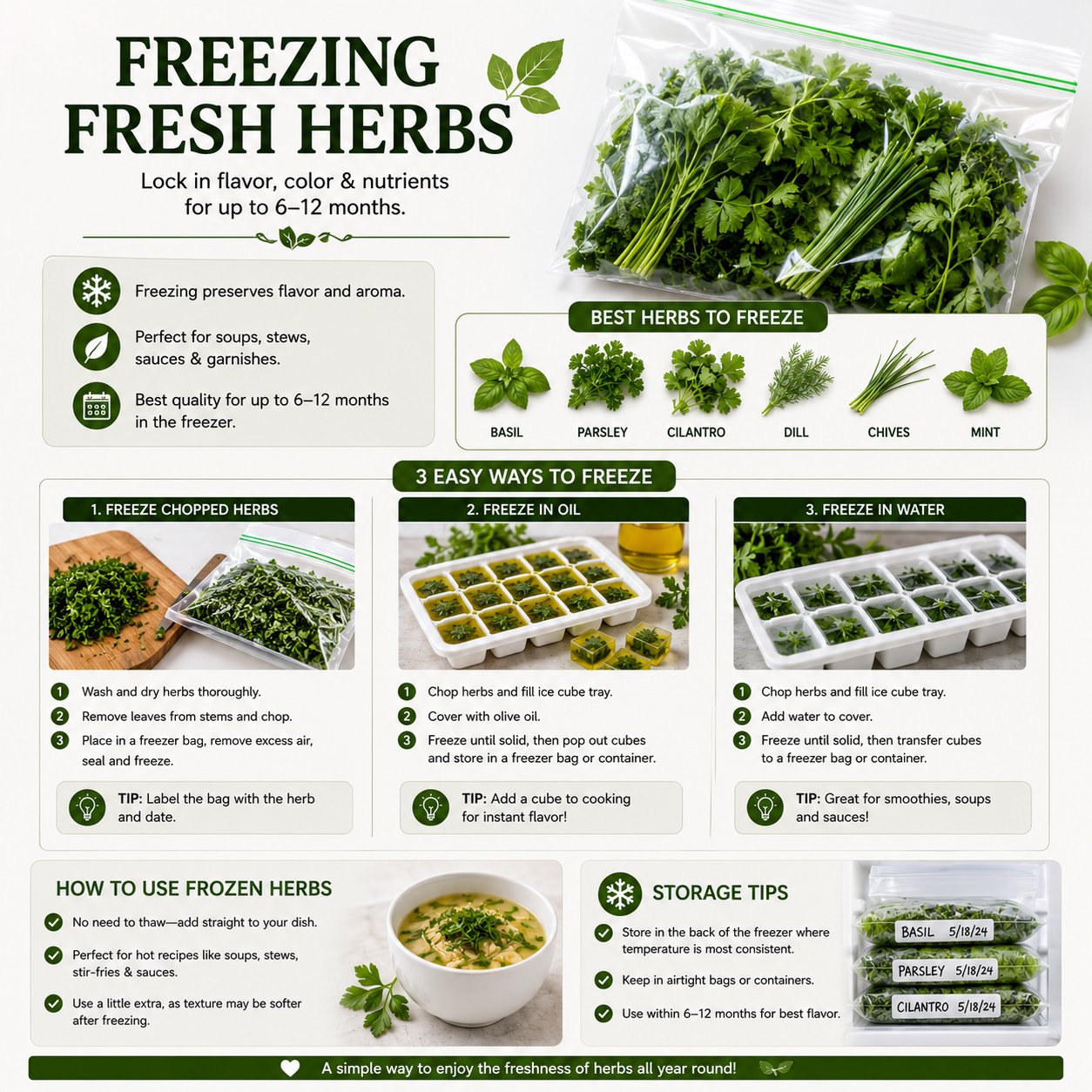
Got a massive bunch of herbs that you’ll never use before they go off? Freeze them. Freezing is one of the smartest, most underused herb preservation tricks out there, and done properly, frozen herbs can retain most of their flavour for up to six months. They won’t have the fresh texture anymore (freezing changes the cell structure), but for cooked dishes, soups, stews, sauces, curries, they work absolutely brilliantly.
Two great ways to freeze herbs
Ice cube method (best for cooking): Chop herbs finely, pack into ice cube trays, cover with olive oil or water, and freeze. Pop a cube directly into soups, stews, or sauces as needed. Label the tray with the herb name and date.
Flat freeze method (quick and easy): Spread whole or roughly chopped herbs on a baking sheet, freeze until solid (about 1–2 hours), then transfer to a labelled zip-lock bag. This keeps them from clumping together so you can grab exactly what you need.
Freeze these very well: Basil · Parsley · Cilantro · Chives · Sage · Thyme · Rosemary
These are not great frozen: Delicate herbs like dill and tarragon lose texture and become mushy, better dried instead
Drying fresh herbs at home
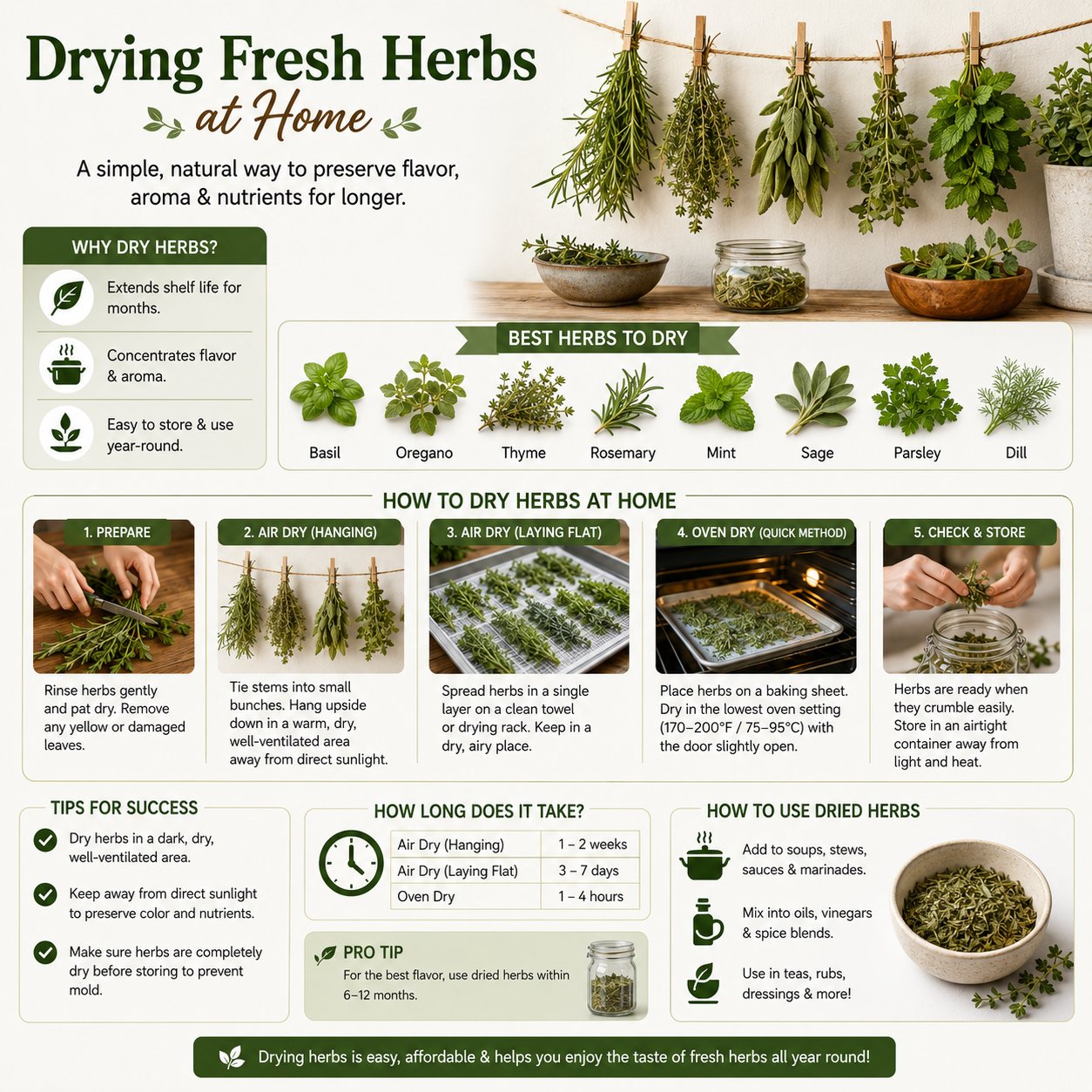
Drying your own herbs at home is deeply satisfying, surprisingly simple, and gives you a product that’s often far fresher and more flavourful than anything you’d find in a store. If you have a glut of herbs from your garden or a bunch that’s about to go over, drying is the perfect solution. Dried herbs last 1–3 years when stored properly, so it’s one of the best returns on a tiny bit of effort.
Air drying (no equipment needed)
Tie small bunches of herbs together at the stems and hang upside down in a warm, dry, well-ventilated spot away from direct sunlight. A kitchen with good airflow works perfectly. Leave for 1–2 weeks until completely dry and crumbly. Best for robust herbs: rosemary, thyme, oregano, sage, lavender.
Oven drying (faster, 1–2 hours)
Spread herbs in a single layer on a baking tray lined with parchment. Set your oven to its lowest temperature (around 40–50°C / 100–120°F). Leave the oven door slightly ajar to allow moisture to escape. Check every 30 minutes, done when they crumble easily between your fingers.
Microwave drying (quickest method)
Place herbs between two sheets of paper towel on a microwave-safe plate. Microwave on high for 1 minute, then in 20-second bursts until dry and crumbly. Works best for small quantities. Watch carefully, overheated herbs can scorch or even spark.
Once dried: Crumble the herbs off their stems, store immediately in airtight glass jars, and label with the herb name and date. Keep in a cool, dark cupboard, and enjoy herbs that taste genuinely better than store-bought.
Fresh herbs don’t have to be a weekly grocery run or a constant battle against wilting. Refrigerate them properly, use the paper towel trick, stand them in water like flowers, freeze what you can’t use, and dry the rest. These five methods together mean you’ll rarely waste a herb again, and your cooking will be better for it every single week.
What is the best way to store spices and herbs in a kitchen?
Keep spices in airtight glass jars inside a cool, dark, dry cupboard — away from the stove, sunlight, and any source of steam. Cool, dark, and dry is the golden rule.
How to keep spices and herbs from getting hard in the cabinet?
Clumping is caused by moisture. Always use a completely dry spoon, never shake directly over a steaming pot, and make sure lids are fully airtight. Store away from the sink and dishwasher.
Is it better to store spices and herbs in glass or plastic?
Glass, always. It doesn’t absorb odors, stains, or chemicals. It seals better, cleans more thoroughly, and lasts longer. Plastic is acceptable short-term but glass is the clear winner for long-term storage.
How do professionals store spices and herbs?
Pros buy whole spices and grind fresh, label everything with dates, rotate stock using FIFO (first in, first out), and smell-test before every service. Small working quantities are kept at the station; bulk is stored in cool, dry storerooms.
What is the mother of all herbs?
Basil. One of the oldest cultivated herbs in the world, used across Mediterranean, Asian, and Indian cuisines for thousands of years. Its name comes from the Greek word for “royal plant” and it lives up to the title.
What are the 8 spices you need in your kitchen?
How to organize a lot of spices and herbs?
Pick a system, alphabetical, by cuisine, or by frequency of use, and stick to it. Standardize your jars, label everything with the name and date, and declutter every 6 months. Magnetic wall jars are great for small kitchens.
Which spice is the king of all spices?
Black pepper is the most widely traded spice in the world, used as currency in ancient times and present in almost every cuisine on earth. Cardamom is the Queen, and saffron is the most expensive, but black pepper rules them all.
Key Takeaways for Spices and Herbs Storage
Cool. Dark. Dry. Airtight. That’s it. Everything else follows from these four words.
Always use glass: First and foremost, glass jars with tight lids are the single best upgrade you can make to your spice storage. Non-negotiable.
Your nose knows: Beyond the visual check, if you can’t smell it, you can’t taste it. The sniff test is, in fact, the most reliable freshness check you have.
Label everything: While you’re at it, put the name and date on every jar. It takes just 10 seconds and saves you years of mystery-powder confusion down the line.
Move away from the stove: Meanwhile, that rack above the hob looks great, but it’s silently destroying your spices. Move it today.
Keep moisture out: In addition to heat, moisture is the fastest route to clumped, ruined spices. Always use a dry spoon, keep the lid tight, and store away from steam.
Buy less, buy fresher: Finally, small quantities restocked often will beat a giant jar of stale powder every single time.
Remember these numbers in spices and herbs storage
3-4 year for whole spices, 1-2 years for ground spices, 1-3 years for dried herbs, 1-2 weeks for fresh herbs
Your one action right now, open your spice cabinet. Pick up one jar. Smell it. If it doesn’t hit you immediately, it’s time for a fresh start. Small changes, big flavor. That’s the whole game.